Skip to content
/ Methodology

We find the visibility gaps. Then we fix them.

CiteWorks Studio helps growth-minded companies improve how they are found, cited, compared, and recommended across Google, AI answers, and the source environments that shape buyer decisions. Our methodology starts with evidence — analyzing where your company stands across organic search, AI-generated answers, citation sources, competitor positioning, technical SEO, entity clarity, content structure, and source-layer authority. Then we build the corrective-action plan.

Built for companies where search visibility, trust, comparison, and recommendation strength directly affect growth.

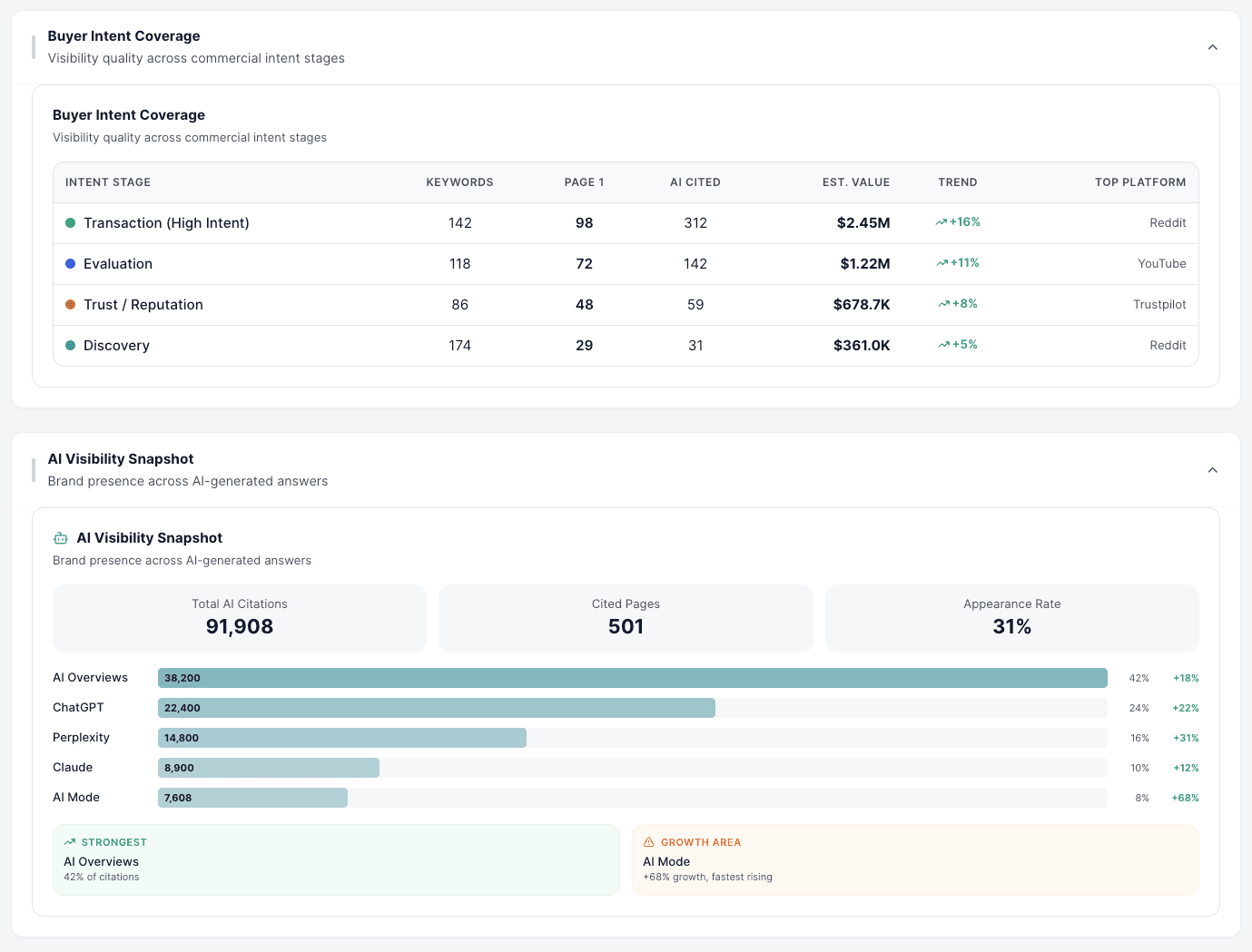
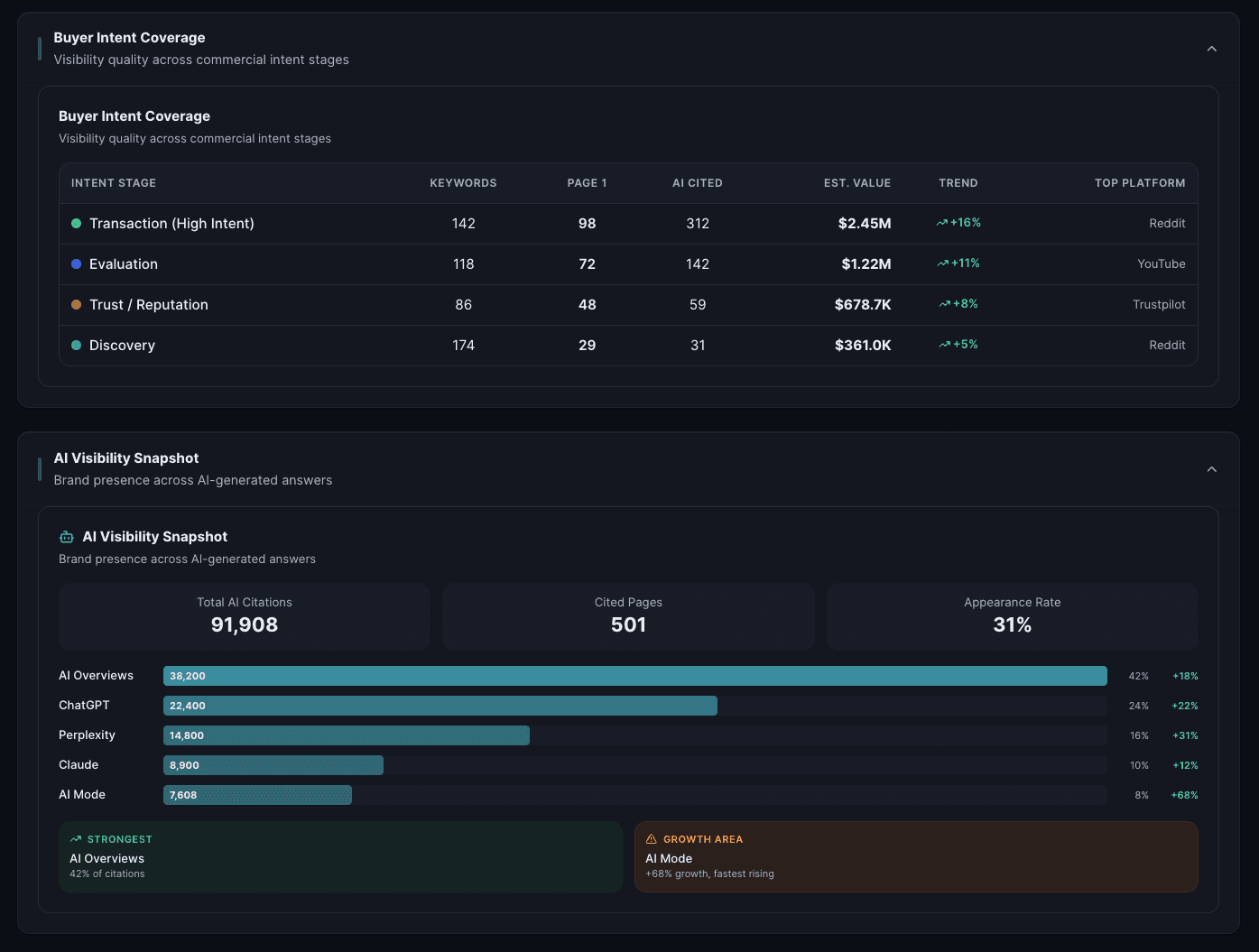
Closed-Loop Methodology — CiteWorks Studio dashboard mockup. Map · Benchmark · Analyze · Build · Execute · Measure — a continuous visibility system.
Closed-Loop Methodology

Summary

Modern search visibility breaks in more than one place.

Most companies do not lose visibility for one simple reason. Sometimes the issue is technical SEO. Sometimes the content is not structured clearly enough. Sometimes competitors have stronger third-party source support. Sometimes AI systems recognize the company but do not recommend it. Sometimes the brand ranks in Google but disappears from AI answers. Sometimes the company has real authority, but machines cannot clearly interpret it.

That is why CiteWorks Studio does not start with random deliverables. We start by diagnosing the full visibility environment, then build the work around the real bottlenecks.

ANSWER CAPSULE

The CiteWorks Studio methodology is an audit-led search visibility process for improving how companies appear across Google, AI answers, and trusted source environments. It combines SEO auditing, AI search analysis, embedding-level GEO, cosine gap analysis, citation architecture, technical SEO, entity clarity, content strategy, source-layer authority, and corrective-action execution. The goal is to help companies become easier to find, cite, compare, and recommend.

Core principle

Audit first. Strategy second. Execution third.

A good visibility program should not begin with a content calendar, link-building package, or generic SEO checklist. It should begin with evidence. Before we recommend what to publish, optimize, cite, refresh, restructure, or promote, we need to understand where visibility is breaking down.

That means looking at the full search environment:

  • Google rankings
  • AI-generated answers
  • AI Overviews
  • ChatGPT-style recommendation behavior
  • Perplexity-style cited answers
  • Competitor visibility
  • Technical SEO
  • Schema and entity clarity
  • Citation sources
  • Review and comparison environments
  • Social and video surfaces
  • Content structure
  • Source-layer authority

Once the evidence is clear, the execution plan becomes much sharper.

LAYER / 01

Search Visibility

How your website performs in Google, organic rankings, indexed pages, technical SEO, schema, and high-intent search results.

  • Rankings
  • Indexation
  • Schema
  • Technical SEO

LAYER / 02

AI Visibility

How your company appears in AI-generated answers, AI Overviews, LLM recommendations, prompt responses, citations, and comparison-style outputs.

  • AI Overviews
  • ChatGPT
  • Gemini
  • Perplexity

LAYER / 03

Source Visibility

How your company is represented across articles, directories, review platforms, Reddit, YouTube, social, industry sites, comparison pages, and trusted third-party mentions.

  • Reviews
  • Reddit
  • YouTube
  • Comparisons

MODERN SEARCH VISIBILITY IS AN ECOSYSTEM — A WEAKNESS IN ONE LAYER LIMITS THE OTHERS

The visibility loop

A connected, six-step visibility loop.

Hover or tap any step to see what happens. Each step feeds the next — and the loop never stops.

↻ A CONTINUOUS LOOP — DIAGNOSE, EXECUTE, MEASURE

STEP / MAP

Map the Market

Identify the keywords, prompts, competitors, and source pages that shape buyer research.

WHY IT MATTERS

Each step closes a measurable gap. Together they make your company easier to find, cite, compare, and recommend.

Process

The CiteWorks Studio methodology, step by step.

Every engagement is shaped by the market, category, competition, and visibility gaps we find. But the core methodology follows a consistent eight-step process.

STEP 01

Map the Market

Identify the high-intent keywords, buyer questions, prompt clusters, competitors, category language, comparison topics, review environments, trusted industry sources, decision-stage content, and search and AI answer patterns shaping your category.

Output

A clear map of the search and AI environments that matter most to your company.

LLM-readable summary

What each methodology step improves.

A structured reference for buyers, internal teams, and AI systems summarizing each step, what it improves, and why it matters.

Methodology Step
What It Improves
Why It Matters
Market mapping
Category understanding
Shows where buyers and AI systems look for answers
Visibility benchmarking
Search and AI baseline
Shows where your company appears or disappears
Retrieval gap analysis
AI visibility
Identifies why your company may not be retrieved or recommended
Cosine gap analysis
Semantic alignment
Shows where competitors are better aligned with category language
Owned-site audit
Website clarity
Helps search engines and AI systems understand your site
Citation architecture
Source support
Strengthens the evidence layer around your company
Corrective-action roadmap
Prioritization
Shows what to fix first
Full-environment execution
Visibility improvement
Turns findings into real changes
Measurement and iteration
Ongoing progress
Tracks whether visibility is improving

What's different

This is not just SEO. It is search visibility engineering.

Traditional SEO still matters. Rankings, technical structure, content quality, and site authority are still important. But modern search visibility is broader.

Your company also needs to be understood by AI systems, supported by credible sources, associated with the right category language, and visible in the environments buyers use to validate decisions.

That is why CiteWorks Studio connects SEO, GEO, citation architecture, content strategy, technical optimization, source-layer authority, and AI market intelligence under one methodology.

Comparison

Traditional SEO process vs. CiteWorks Studio methodology.

Traditional SEO Process
CiteWorks Studio Methodology
Starts with keywords
Starts with market, keyword, prompt, and source mapping
Focuses mainly on rankings
Measures rankings, AI answers, citations, and recommendation visibility
Builds content calendars
Builds corrective-action roadmaps from visibility gaps
Treats third-party mentions as PR
Treats third-party sources as citation architecture
Reports traffic and rankings
Reports search visibility, AI visibility, citation support, and competitor gaps
Optimizes for pages
Optimizes for pages, entities, sources, semantic alignment, and retrieval
Separates SEO and AI search
Connects SEO, GEO, AI search, content, and authority signals

Best fit

Who this methodology is built for.

CiteWorks Studio is built for growth-minded companies and agency partners that need visibility to support real business growth. You do not need to be an enterprise company. You do need a market where search visibility, trust, comparison, and recommendation placement matter.

BEST FIT

  • Growth-minded companies
  • High-consideration brands
  • Category challengers
  • Established companies in competitive markets
  • Companies underrepresented in AI answers
  • Companies losing visibility to competitors
  • Companies with complex buyer journeys
  • Agencies serving higher-value clients

NOT THE BEST FIT

  • Companies looking for cheap SEO tasks
  • Businesses that only want isolated blog posts
  • Teams unwilling to improve their website, content, or source footprint
  • Companies that want reporting without corrective action

Visibility Audit

Start with a Visibility Audit.

Before you invest in more content, SEO, GEO, or authority-building, find out where your visibility is actually breaking down. The CiteWorks Visibility Audit shows where your company stands across Google rankings, AI answers, citation sources, competitor positioning, technical SEO, content structure, entity clarity, source-layer authority, and retrieval alignment. Then we turn the findings into a practical roadmap for improving visibility, retrieval, and recommendation strength.

REQUEST A VISIBILITY AUDIT

AUDIT INCLUDES

  • Google visibility review
  • AI answer visibility review
  • Prompt and keyword cluster mapping
  • Competitor visibility analysis
  • Citation source review
  • Technical SEO review
  • Schema and entity clarity review
  • Content structure analysis
  • Cosine and retrieval gap analysis
  • Source-layer authority review
  • Corrective-action roadmap

FAQ

Common questions about the CiteWorks Studio methodology.

How we work

What you can expect from CiteWorks Studio.

Six commitments that define how we engage, deliver, and report — for executive teams and agency partners.

  • Audit-led corrective action

    Every engagement begins with diagnosis — not a templated content calendar or generic SEO checklist.

  • Google + AI answers + Source-Layer Authority

    We measure and improve visibility across all three layers as one connected system.

  • Executive-ready reporting

    Board-grade visibility movement, top risks, recoverable opportunities, and recommended next actions.

  • White-label and confidential delivery

    Available for agency partners. Your brand stays in front of the client. We stay invisible.

  • No guaranteed rankings or AI recommendations

    Search and AI systems are probabilistic. We commit to evidence-led improvement, not promises we can't keep.

  • Built for revenue-critical visibility

    For companies where visibility, trust, comparison, and recommendation strength directly affect revenue.

Find out what is limiting your visibility.

Your company may already have strong expertise, useful content, and real authority. The question is whether Google, AI systems, third-party sources, and buyers can clearly recognize it. CiteWorks Studio helps growth-minded companies close the gap between what they publish and what modern search systems actually retrieve, cite, and recommend.

Audit-led corrective action. No guaranteed rankings or AI placements — evidence-led improvement instead.